

Is Your Bank Stealing Your Future? The 10-Minute Switch That Earns You Hundreds
Let me ask you a quick question.
If I gave you $1,000 today and told you that in five years, it would still say exactly "$1,000" on your bank statement, would you feel like your money was safe?
To most of us, that feels like the definition of "safe." The number didn't go down. Nothing was stolen. But here is the hard, uncomfortable truth: Even though the number stays the same, your money is actually losing value every single year. While you sleep, while you work, and while you diligently save for your future, a silent thief is siphoning off your purchasing power. Today, I’m going to show you exactly how this is happening—and why one simple switch to a High-Yield Savings Account (HYSA) is the single most important financial move you can make this week.
The $1 Tragedy: The Problem with Traditional Accounts
Most people keep their hard-earned cash in one of two places: a checking account or a standard savings account at a major "brick-and-mortar" bank. These accounts are great for convenience, sure. You can find an ATM on every corner, and the brand name feels secure.
But convenience comes at a massive cost.
As of my research this week—April 6, 2026—the average savings account at the "big" US banks is paying a measly 0.01% interest. Let’s look at what that actually looks like in your pocket:
If you have $10,000 sitting in a traditional account:
Interest earned in one year: $1.00.
Impact: That wouldn't even buy you a cup of coffee, let alone cover the monthly "maintenance fees" most of these banks charge.
Think about that for a moment. You are giving the bank your money to lend out, to invest, and to profit from, and in exchange, they are giving you a single dollar bill once a year. It’s not just unfair; it’s an insult to your hard work.
Inflation: The Invisible Thief
If earning $1 on $10,000 sounds bad, the reality is actually worse. Enter: Inflation.
Inflation is the rate at which the cost of goods and services rises. What $100 could buy you last year might cost $103 or $105 today. In the US, current inflation is hovering around 2.4%, but recent forecasts for April 2026 suggest we could see a jump toward 3.28% due to rising energy costs.
Here is the math your bank doesn’t want you to do:
Your Interest Rate: 0.01%
Inflation Rate: 3.28%
Your Real Return: -3.27%
You aren't "breaking even." You are losing 3.27% of your money’s buying power every single year. Even though your balance still says $10,000, that $10,000 can now only buy $9,673 worth of groceries, rent, or gas compared to a year ago. Your money is quietly shrinking while it sits "safely" in your account.
The Escape Hatch: What is a High-Yield Savings Account?
This is where the High-Yield Savings Account (HYSA) changes the game. An HYSA is a savings account that pays you significantly more interest than traditional accounts—often 300 to 400 times more.
The advantages are straightforward:
No Market Risk: Unlike the stock market, your principal investment doesn't fluctuate. If you put in $1,000, you have $1,000 (plus interest).
Immediate Access: You aren't "locking" your money away. You can transfer it back to your checking account whenever you need it.
Compound Growth: You earn interest on your interest.
The 2026 Comparison: Same Money, Different Outcome
I spent time this morning looking at nine different US bank websites. While the big banks are still stuck in the 0.01% dark ages, online-focused banks and smaller institutions are competing for your business.
Currently, top-tier HYSAs are offering rates between 3.80% and 4.21% APY. Let’s compare the outcomes for that same $10,000:
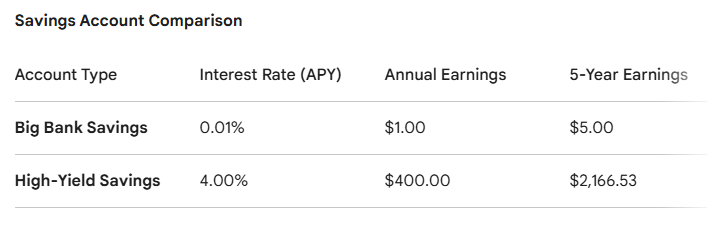
In five years, the person with the High-Yield account has $2,161 more than the person at the big bank. That is a vacation, a down payment on a car, or a massive boost to an emergency fund—all for doing literally nothing other than changing where the money sits.
Why Do High-Yield Accounts Pay So Much More?
You might be wondering: “If they can pay 4%, why doesn’t my bank do it?”
The answer is simple: They don’t have to. Big banks have massive marketing budgets and millions of loyal customers who stay out of habit. They have expensive physical branches on every street corner to pay for.
Most High-Yield accounts are offered by online banks. Because they don't have the overhead of thousands of physical buildings and tellers, they can pass those savings on to you in the form of higher interest.
Is it safe? Absolutely. As long as you choose a reputable bank that is FDIC-insured, your money is protected by the federal government for up to $250,000, just like it is at Chase, Bank of America, or Wells Fargo.
How to Manage Your Money Like the Top 1%
The wealthiest people don't let their cash sit idle. They make sure every dollar has a "job." Here is the strategy I use to ensure my money is always working for me:
Income Inflow: Every paycheck or bit of income I receive goes directly into my High-Yield Savings Account first. Not my checking.
Earn Immediately: From day one, that money is earning 4% interest.
Allocate as Needed: Only when I have a bill to pay or need spending money do I move a specific amount into my checking account.
This keeps the bulk of my cash earning the maximum possible interest for as long as possible. It’s a small psychological shift that leads to huge financial gains over time.
Your 10-Minute Action Plan
You’ve worked too hard for your money to let it lose value in a stagnant account. Here is your challenge for the week:
Check Your Rate: Log into your banking app right now. Find your "Annual Percentage Yield" (APY). If it's less than 3.5%, you are losing money.
Compare: Look at reputable online banks like Alliant, Capital One, American Express (yes, they're not just a credit card company), SoFi or Wealthfront. (As of today, April 8, 2026, many are offering 4% or higher). Check out my YouTube Video for rates offered by some of these banks.
Note: I am not receiving any form of payment for mentioning these names.
Open and Transfer: Opening an account online usually takes less than 10 minutes. You don't even have to leave your couch.
The "Safety Test": If you’re nervous, don't move everything at once. Transfer $500 or $1,000 and watch the interest hit next month. Once you see that "Interest Credited" line is $30 instead of $0.03, you’ll never want to go back.
The Bottom Line
Your money should not just sit there. It should grow. In 2026, "saving" isn't enough—you have to be a smart steward of your wealth. Take ten minutes this week to stop the "Big Bank Tax" and start getting paid what you’re worth.
