
Demystifying the Stock Market Hierarchy
Demystifying the Stock Market Hierarchy
I see it happen all the time. Someone decides they want to stop trading every hour of their life for a paycheck and start building real wealth. They open up a trading account, full of ambition, only to be hit smack in the face by a wall of financial alphabet soup.
SPY, QQQ, XLK, SMH. NVDA.
Suddenly, what felt like a path to freedom starts looking like a closed club hidden behind a secret code. The jargon acts like a barrier, whispering, "This isn't for you."
At Mindshift Theory, we reject that entirely. Our mission is to focus on clarity over complexity and progress over perfection. The stock market is not a playground reserved for elites; it is an open ecosystem, and once you understand its mechanics, you realize it is completely accessible to anyone willing to learn.
Let’s strip away the confusion, break down the jargon, and look at exactly how the global market is structured from top to bottom.
The Core Mechanics
Before we look at the ladder, we have to understand what the rungs are made of. Let's redefine four core terms in plain English:
The Market: Think of the stock market as a massive global bazaar. Instead of trading rugs or spices, people are buying and selling tiny pieces of ownership (shares) in public companies.
An Index: An index is just a mathematical scoreboard. You cannot buy an index directly because it’s a concept, not a product. It simply tracks how a specific group of stocks is doing collectively.
An ETF (Exchange-Traded Fund): Because you can't buy a scoreboard, Wall Street created ETFs. An ETF is a basket of stocks that you can buy and sell like a single stock. A fund company buys all the stocks in an index, packages them into a single fund, and lets you buy a tiny slice of that bundle.
A Themed / Sector ETF: While standard ETFs copy the whole scoreboard, a themed or sector ETF narrows its camera angle. It bundles companies based on a specific slice of the economy (like Technology) or a specific trend (like Cybersecurity).
The 6-Layer Market Hierarchy
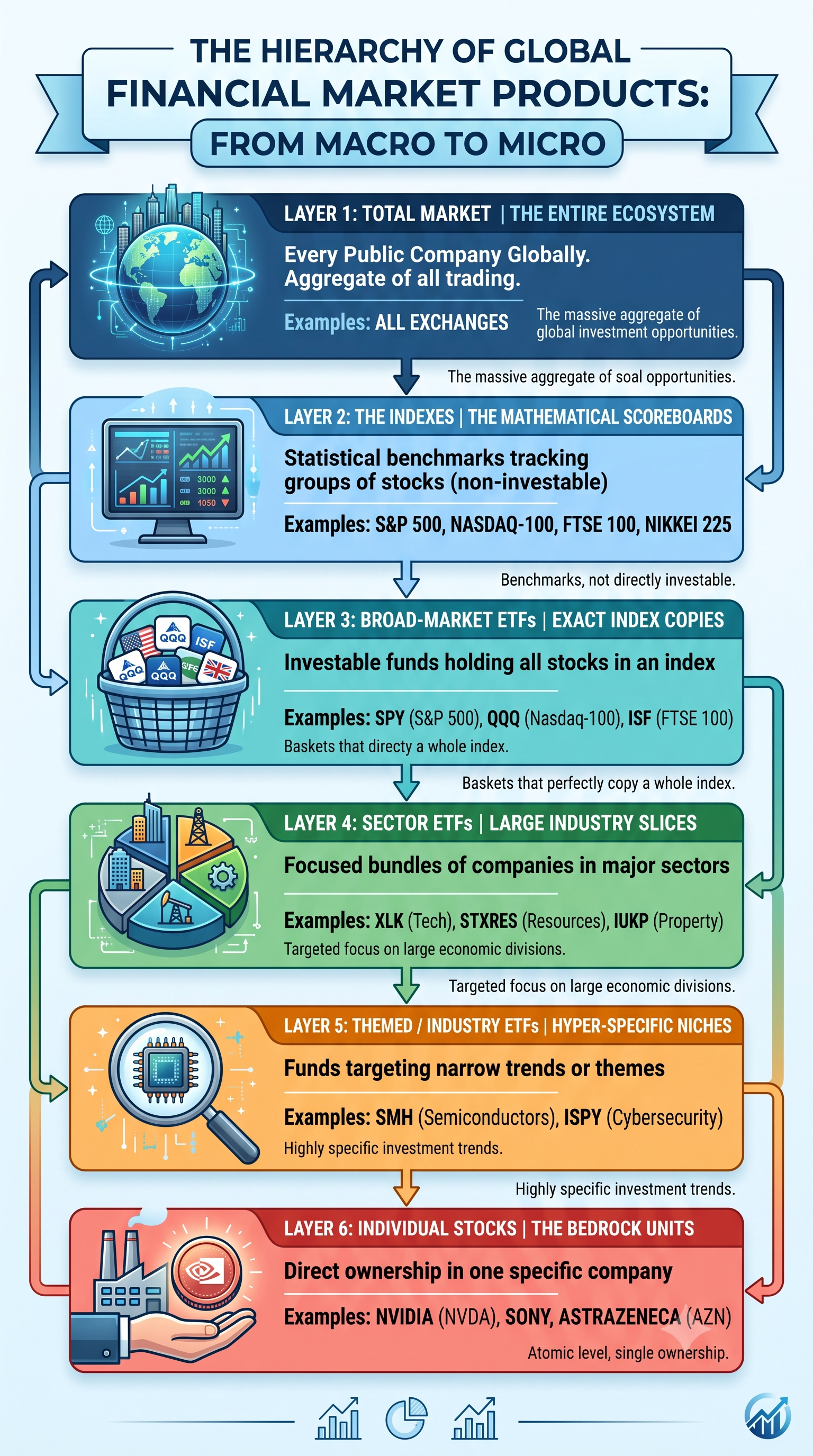
Think of the market structure like a pyramid, moving from the broadest view at the top down to the hyper-specific, atomic unit at the bottom.
Layer 1: The Total Market
This is the broad canopy. It is the entire global ecosystem where every public company lives and trades.
Layer 2: The Indexes (The Scoreboards)
This is where concepts like the S&P 500 and the Nasdaq-100 live. The S&P 500 tracks roughly 500 of the largest, most influential companies in the US. The Nasdaq-100 tracks the 100 largest non-financial companies, giving it a heavy bias toward tech and innovation.
Layer 3: Broad-Market ETFs (The Direct Copies)
This is where regular investors get to participate. Broad ETFs mirror those Layer 2 scoreboards exactly.
SPY (SPDR S&P 500 ETF Trust): Buying one share of SPY means you instantly buy a tiny piece of Apple, Microsoft, Amazon, and 497 others.
QQQ (Invesco QQQ Trust): This does the same thing, but copies the Nasdaq-100 scoreboard.
Layer 4: Sector ETFs (The Big Slices)
Now we are narrowing our focus. A sector ETF strips away the rest of the market to focus on one specific industry.
XLK (Technology Select Sector SPDR Fund): If you don't want to own oil companies or banks from the S&P 500, XLK filters them out. It holds only the tech heavyweights within that index. See list of sectors at the bottom of this article.
Layer 5: Themed / Industry ETFs (The Micro-Focus)
This layer zooms in even closer, hunting for hyper-specific industrial niches or structural trends.
SMH (VanEck Semiconductor ETF): Technology (Layer 4) is massive. SMH bypasses software and cloud computing companies to target the actual physical computer chips (semiconductors) powering those technologies.
Layer 6: Individual Stocks (The Bedrock Units)
This is the ultimate granular layer. Without individual companies, none of the layers above could exist.
The Blueprint: If you buy a share of Nvidia (NVDA), you own a piece of one business. Nvidia is the anchor of the SMH chip ETF (Layer 5), which is a massive part of the XLK tech ETF (Layer 4), which commands a huge percentage of QQQ and SPY (Layer 3), which track the major indexes (Layer 2) trading on the open market (Layer 1).
Side-by-Side Product Comparison
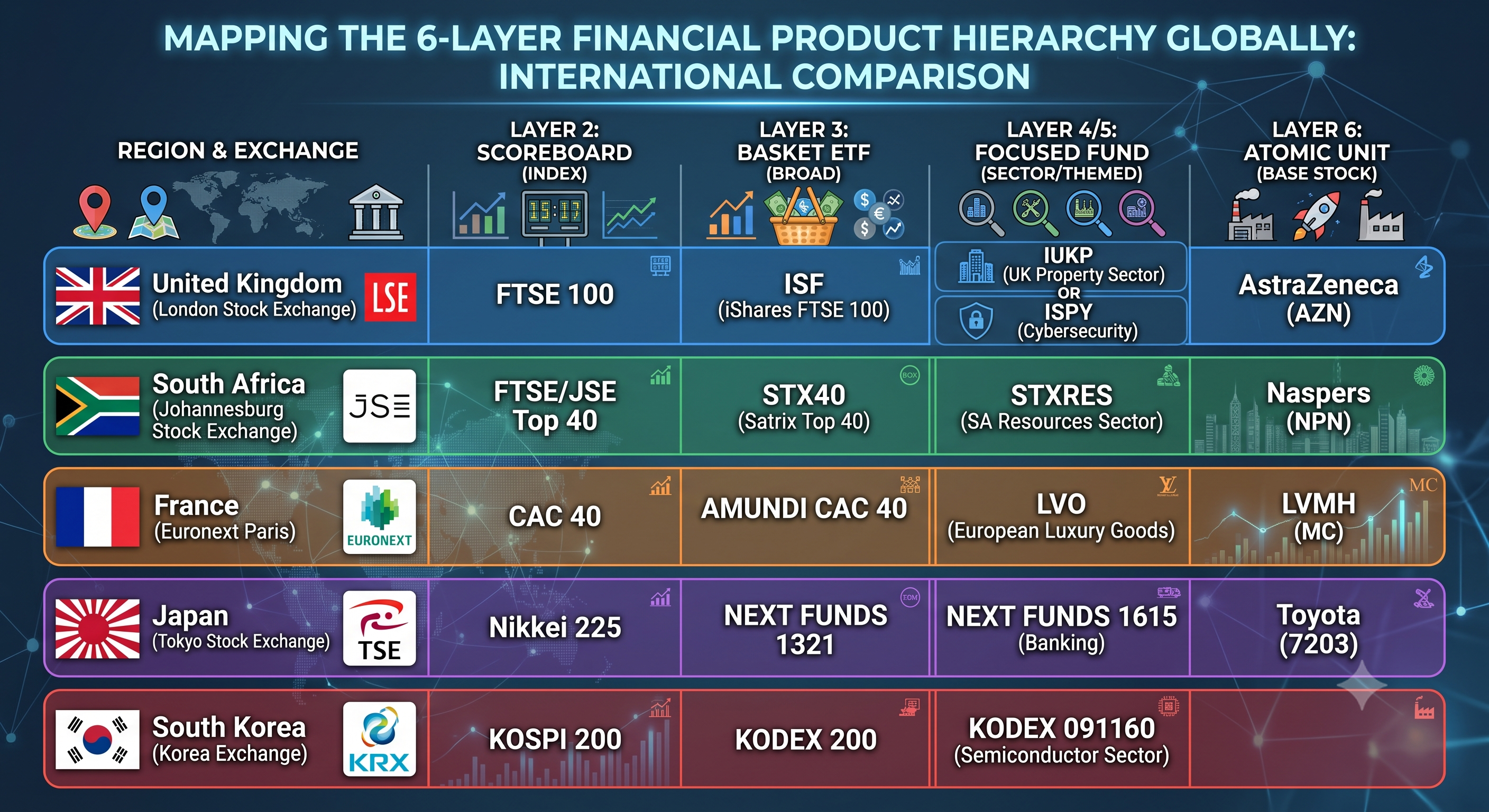
What I love most about this structure is that it isn't just an American phenomenon. At Mindshift Theory, we talk a lot about global movement and universal principles. Whether you are trading in New York, London, or Johannesburg, the mechanics of the market remain exactly the same.
Look at how this identical 6-layer framework maps across different international landscapes:
Shifting Your Perspective
"Most people spend their lives trading time for a paycheck. True financial shift happens when you learn how to turn your capital into a source of security, growth, and consistent income."
When you look at the stock market as a chaotic mess of ticker symbols, it’s intimidating. But when you look at it through this structured hierarchy, you realize it’s just a logical system of layers designed to let you choose your exact level of focus.
If you want ultimate diversification across the entire economy, you build your foundation in Layer 3 (Broad ETFs). If you have a strong belief in a specific technological future, you lean into Layers 4 and 5 (Sector and Themed ETFs). And if you want to back a single corporate giant, you drop straight down to Layer 6 (Individual Stocks).
There is no "secret code." There is only clarity over complexity. Once you understand the mechanics, the market belongs to you just as much as anyone else. It's time to flip the script.
Come and join us at the Wealth Circle for more simplified investing and stock market knowledge.
Best,
Ricardo and Michele
PS: as promised here are your 11 sectors for the S&P.
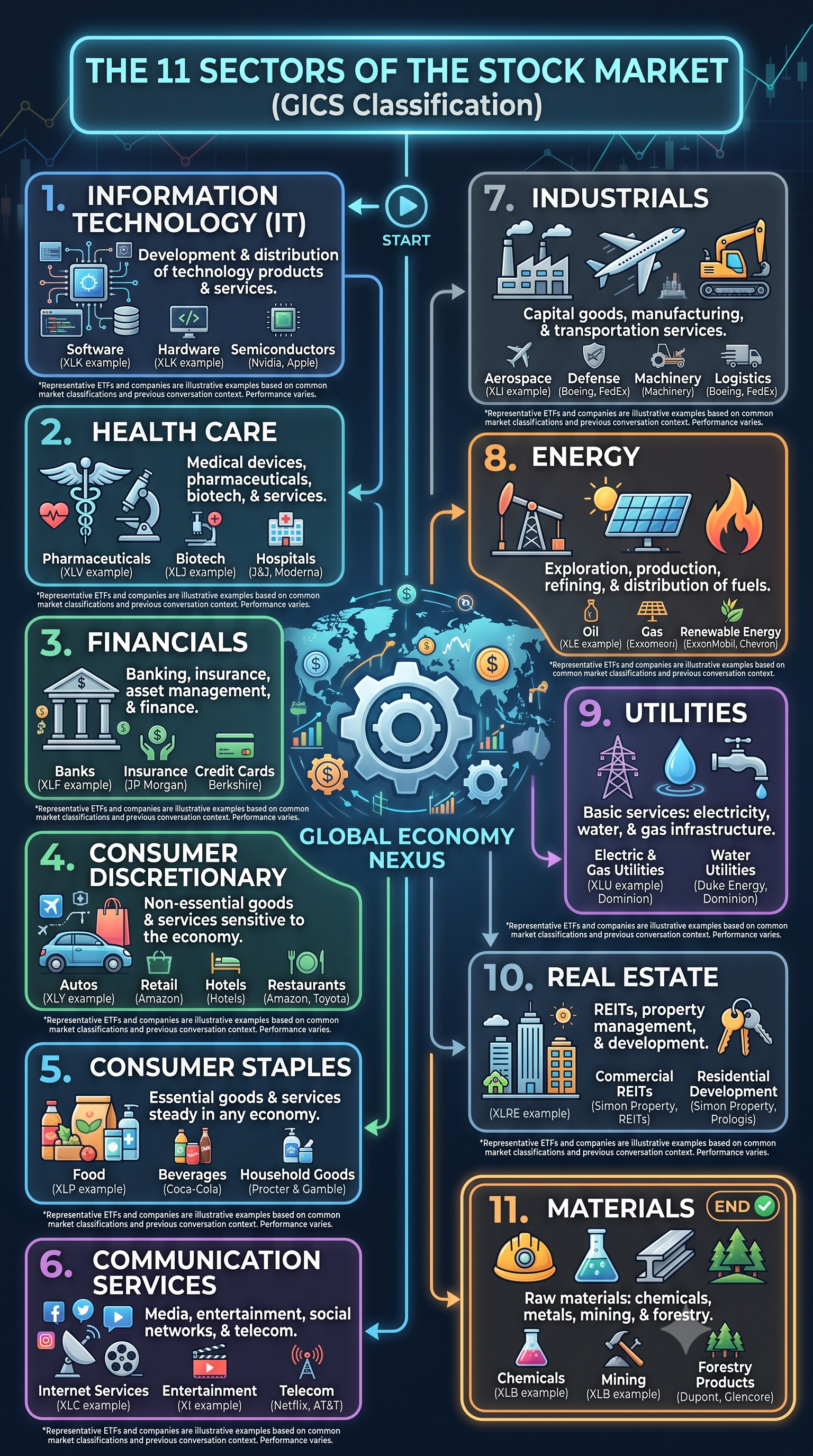
XLK: Technology- Technology companies
XLF: Financials - Big banks, insurance companies, asset managers, and credit card providers.
XLV: Health Care - Pharmaceuticals, biotechnology, medical devices, and healthcare systems.
XLY: Consumer Discretionary - Non-essential goods and services that people buy when they have extra cash (e.g., retail, luxury brands, autos, restaurants, travel).
XLP: Consumer Staples - Everyday essentials that people buy regardless of the economy (e.g., household products, food, beverages, hygiene items).
XLC: Communication Services - Interactive media, social networks, entertainment, streaming giants, and telecom providers.
XLI: Industrials - Aerospace, defense, heavy machinery, construction, logistics, and transportation.
XLE: Energy - Companies involved in oil, gas, consumable fuels, and related drilling equipment/services.
XLU: Utilities - Electric, water, and gas companies providing the vital infrastructure that keeps society running.
XLRE: Real Estate - Real Estate Investment Trusts (REITs), residential developments, and commercial property managers.
XLB: Materials - Companies providing raw building blocks—chemicals, mining, metals, and packaging materials.
Understanding these tickers is how you transition from an observer to a strategic architect of your own wealth. Instead of buying the entire market, you can use these exact vehicles to tilt your capital toward the specific sectors you believe will outperform. The tools are right in front of you—all it takes is the shift in perspective to use them.