

Home Depot Dividend Deep - 8 May 2026
How We Use Home Depot and the "Wealth Triangle" to Build Unstoppable Passive Income
Home Depot is one of those retail giants that every DIYer eventually finds themselves at. Whether you are picking up a fresh box of drywall anchors, wandering down the plumbing aisle trying to fix a leaky sink, or loading up your truck with fresh mulch for the spring, it is a place that just feels familiar. It is excellent for picking up the tangible supplies you need to improve your home, but could it also be an absolute powerhouse candidate inside your dividend portfolio?
Today, I want to sit down and pull back the curtain on Home Depot (ticker: HD) from an investor’s perspective. We are going to look at this stock not just as a place to spend our hard-earned weekend cash, but as a potential machine designed to build long-term wealth. To do that, we are going to dive deep into a strategy we call the Wealth Triangle here at MindShift Theory. Here is exactly what we are going to explore together: the underlying core fundamentals of the business, the technicals on the stock chart (including exactly where the best buying opportunities are currently hiding), how to make this single investment pay you three different times simultaneously, and finally, a quick pulse check on overall market sentiment so you know what the big players on Wall Street are thinking. Let's jump right in.
Part 1: Checking Under the Hood (The Fundamentals)
When I am looking at adding a stock to my long-term portfolio—or even evaluating a position I already own—I like to treat it exactly like buying a used truck. I don’t just care about the shiny paint job on the outside; I want to pop the hood, look at the engine, check the oil, and make absolutely sure it can haul a heavy load when the terrain gets rough. For a mature, blue-chip retail giant like Home Depot, that means looking past daily stock market noise and staring directly at the cash generation metrics.
Right now, Home Depot is trading around the $311.40 mark. If we look at the standard Price to Earnings (P/E) ratio, it is hovering just under 22 at 21.88. To give you some context, over the last five years, Home Depot has typically commanded a P/E closer to 23 or 24. So, seeing it sit under 22 tells me right off the bat that the market has slapped a bit of a "sale" sign on the company. We aren't paying premium bubble prices here; we are buying a top-tier business at a slight historical discount.
Key Fundamental Metrics at a Glance
Stock Price: $311.40 (Current market entry point per share)
P/E Ratio: 21.88 (Trading below its 5-year historical average of ~23x)
Price to Cash Flow: 19.03 (Healthy efficiency; generating clear cash relative to capitalization)
Free Cash Flow per Share: $12.65 (The fundamental engine keeping our dividend payouts safe)
Dividend Payout Ratio: 65.5% (Sustainable balance between rewarding owners and self-funding growth)
But P/E only tells part of the story. As dividend and income-focused investors, what we care about more than anything else is cold, hard cash flow. Earnings can be manipulated by accountants using clever depreciation tricks, but cash flow is real money passing through the registers. Currently, HD’s Price to Cash Flow (P/CF) ratio is sitting comfortably at 19.03. Anything under 20 for an established retail kingpin indicates a highly efficient business that knows exactly how to squeeze profits out of its physical footprint.
Even better, if you look at their Free Cash Flow (FCF) per share, it is a robust $12.65. Think about what that represents. After Home Depot pays for all its global operations, cuts checks to its employees, keeps the lights on across thousands of massive warehouses, and completely reinvests in its own capital expenditures (like upgrading its supply chains and digital platforms), it is still left with a massive mountain of cash equivalent to $12.65 for every single outstanding share. That cash is the ultimate safety net.
Because they have such a strong cash cushion, their annual dividend payout of $9.32 per share is incredibly secure. This brings their dividend payout ratio relative to earnings to about 65.5%. Now, a 65.5% payout ratio might look a little high if this were a fast-growing tech company that needed every dime to build data centers, but for a mature retail powerhouse, it is actually a beautiful sweet spot. It means they are aggressively returning cash to us, the shareholders, while still holding back a 34.5% reserve to protect the balance sheet and fund strategic initiatives. It is a reliable, stress-free setup that lets me sleep easily at night.
Part 2: The Wealth Triangle Strategy (Making One Asset Pay You Three Times)
Let's shift gears and talk about how we actually maximize this asset. Most traditional investors buy a stock like Home Depot, stick it in an account, and just hope the price goes up while waiting every three months for a dividend check to roll in. To me, that is like buying a beautiful piece of investment real estate and just letting it sit vacant, hoping the neighborhood goes up in value, without ever collecting a monthly rent check from a tenant. Why do that when you can actively monetize the property?
Here at MindShift Theory, we use a framework called the Wealth Triangle to turn a standard buy-and-hold equity position into an active cash-flowing machine. The strategy uses three distinct sides to build compounding momentum:
The rock-solid baseline dividend paid directly by the company.
Selling conservative, short-term covered calls to generate immediate weekly income.
Taking all that premium cash and immediately using dollar-cost averaging (DCA) to buy more shares.
Let’s walk through how this works in the real world using the numbers from this year. Imagine you already own 100 shares of Home Depot. Because you own those 100 shares, you have the legal right to sell options contracts against them. Now, we don't want to be greedy or reckless here; we aren't trying to swing for the fences and risk having our shares ripped away from us during a massive market rally. Instead, we play a high-probability game by selling weekly covered calls at a conservative 20-delta.
If you aren't familiar with option terms, don't worry—think of "20-delta" as a statistical insurance metric. In plain terms, it means the option contract we are selling only has roughly a 20% statistical chance of ending up "in the money" by the end of the week. Flip that math around, and it means you have an 80% probability that the contract will expire completely worthless, allowing you to keep your 100 shares safe and sound while pocketing the buyer's premium as pure cash flow. For a stable blue-chip like HD, a weekly 20-delta strike price is usually positioned comfortably about 2.5% to 3.5% above where the stock is currently trading.
Because Home Depot has experienced a healthy dose of volatility this year, those options premiums have been surprisingly juicy. If you had been executing this process week after week from January 1 through mid-May, the numbers would look downright impressive. On average, you would have been collecting a weekly premium of roughly $1.85 per share. When you multiply that across your 100-share contract over a 19-week period, you find yourself sitting on a total gross premium income of approximately $3,525.79 year-to-date!
Think about the psychological shift that occurs here. While the rest of the market is staring nervously at their portfolios, stressing out because the absolute price of the stock has dipped, you have quietly extracted over $3,500 in pure cash out of thin air. And what do we do with that cash? We don't go out and blow it on an expensive dinner or a new gadget. We loop it right back into the bottom of our Wealth Triangle via systematic Dollar-Cost Averaging.
At Home Depot’s current price of roughly $311, that $3,525 in generated options premium allows you to purchase roughly 11 additional shares completely for free, without dipping into your primary paycheck or bank savings. Those 11 new shares immediately start earning their own dividends, compounding your future payouts, and expanding your asset base. You are literally utilizing the market’s own short-term volatility to buy a piece of the company at a steep discount. That is how real financial momentum is built.
Part 3: Reading the Chart (Where Are the Buying Opportunities?)
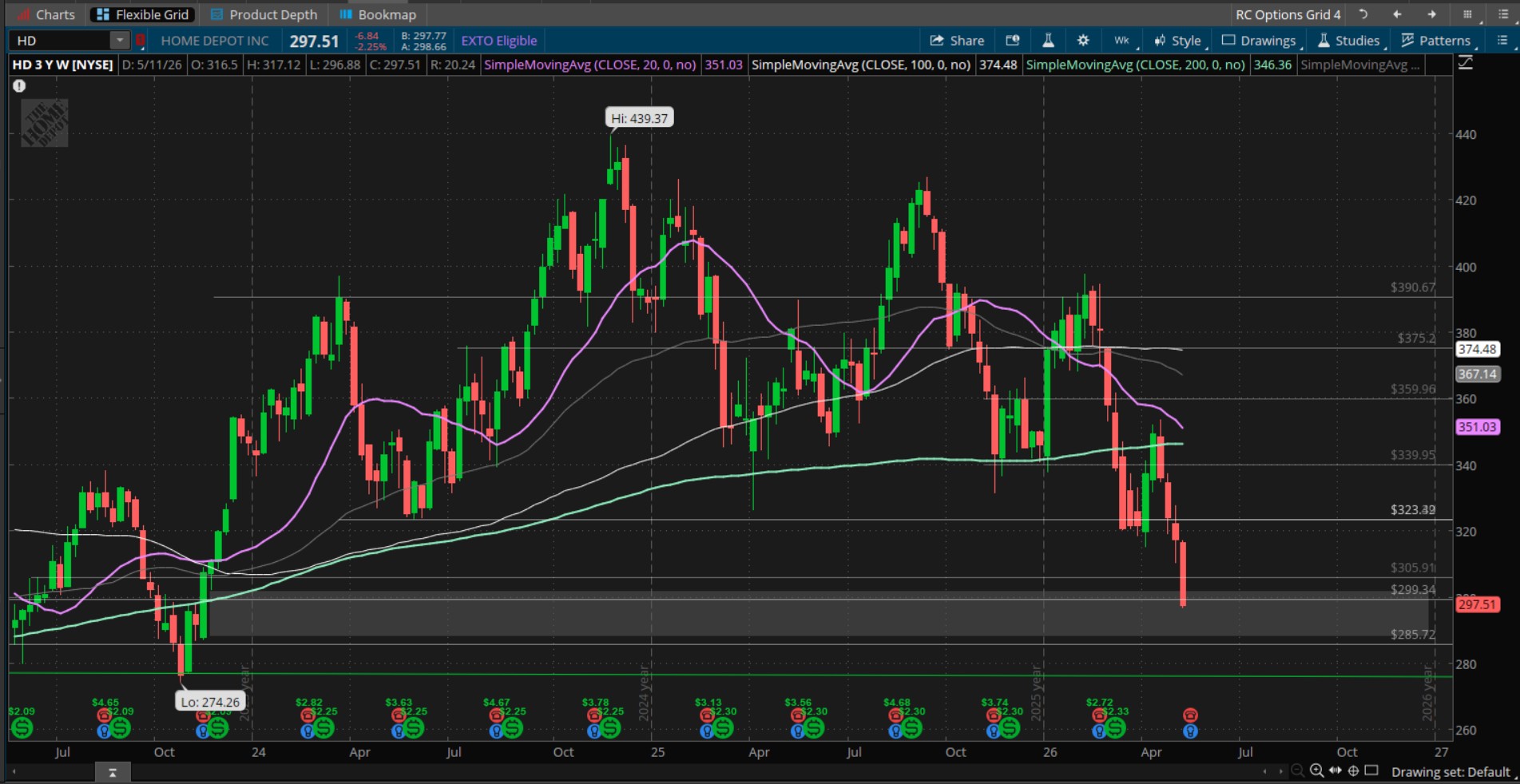
Now that we have the fundamental framework and our strategy fully locked in, let's pull up the technical stock chart together and look at exactly where the smart money is putting capital to work. If we look at the chart over the last few months, it is very clear that Home Depot has had a tough run. After charging up to a peak near $390 back in February, the stock has locked into a steady, downward-sloping bearish channel, sliding all the way down to our current level in the low $311s.
For an emotional, short-term trader, a chart like this looks terrifying. But for a long-term cash-flow investor using the Wealth Triangle, this chart looks like an absolute playground. We are currently approaching what I call a major "capitulation and bounce" zone, where the downside risk starts to get heavily capped by massive institutional buying interest.
The Key Support Levels to Watch:
The Floor ($305 – $310): This is our immediate line in the sand. Just recently, the stock dipped down to touch an intraday low of $309.71. That area represents a major psychological defense line and sits right on the edge of its 52-week lows. When a blue-chip stock hits its 52-week low while its underlying business remains highly profitable, institutional algorithms and value investors historically step in to build a "double bottom" support base. This is an incredibly attractive spot to execute your weekly DCA purchases.
The "Back-Up-The-Truck" Zone ($300): If the broader stock market experiences a sudden panic selloff and the $309 level fails to hold, I am keeping my eyes glued to the round, psychological number of $300. On a long-term volume profile chart, $300 represents an enormous high-volume node. This means an immense amount of shares have changed hands at this level historically, making it a critical stronghold. If Home Depot shares touch $300, that is my personal signal to get highly aggressive with share accumulation.
The Reversal Resistance Level:
The Breakout Target ($334): On the upside, we aren't out of the woods just yet. To officially break this current bearish downward trend, Home Depot needs to put together a strong rally and print a daily close above the $334 mark. If it can break through that resistance line, it will signify a complete trend reversal, likely clearing a straight path back up toward the $350 and $370 ranges. Until then, we are perfectly content to let the stock linger down here in the bargain bin, collecting cheap shares every single week.
Part 4: Reading the Room (Market Sentiment)
To wrap our analysis up, let's take a quick look at market sentiment. Why exactly is Home Depot down in the dumps right now while the broader tech sectors have been flying high? It all boils down to macroeconomics and the housing market. Wall Street is currently terrified of a prolonged period of higher interest rates. When mortgage rates remain elevated, home sales slow down dramatically. Because fewer people are buying new homes, fewer people are engaging in massive, multi-thousand-dollar renovation projects before moving in.
Additionally, there is a general narrative floating around that the post-pandemic "DIY boom" has completely cooled off, and that the average consumer is feeling a bit of wallet fatigue from inflation. This negative narrative is exactly why the stock is being punished. But here is the secret: Wall Street thinks in quarters, while wealth-builders think in decades.
Does anyone honestly believe that people will stop repairing their homes over the next ten years? Is a temporary slowdown in housing turnover going to permanently break a business with a near-monopoly duopoly alongside Lowe's? Absolutely not. The physical infrastructure, brand loyalty, and supply chain dominance that Home Depot commands are virtually impossible to replicate. The current negative sentiment is a classic macro-driven mispricing—giving long-term thinkers a beautiful window of opportunity to acquire a cash-flowing asset at a discount.
Personally, I am staying completely locked into the strategy. I am letting my 100 shares sit safely in place, running my weekly 20-delta covered calls, collecting that sweet premium cash flow, and using it to grab more shares while they are sitting heavily discounted in the $310 range. If the stock drops lower, my options premium buys even more shares. If the stock shoots up, my underlying equity value skyrockets. When you set up the Wealth Triangle correctly, you stop caring which way the market moves tomorrow, because the machine is designed to win either way.
Join our:
👬🏼Community: https://www.wealthlab.mindshifttheory.io
💵 The Millionaire Method: https://www.mindshifttheory.io/millionaire-method
👇 Connect:
🌐 Website: https://mindshifttheory.io/
📘 Facebook: https://www.facebook.com/mindshifttheory
📸 Instagram: https://www.instagram.com/mindshift.theory